Product design · Authentication · Responsive web
SecureGate — Authentication & Security Platform
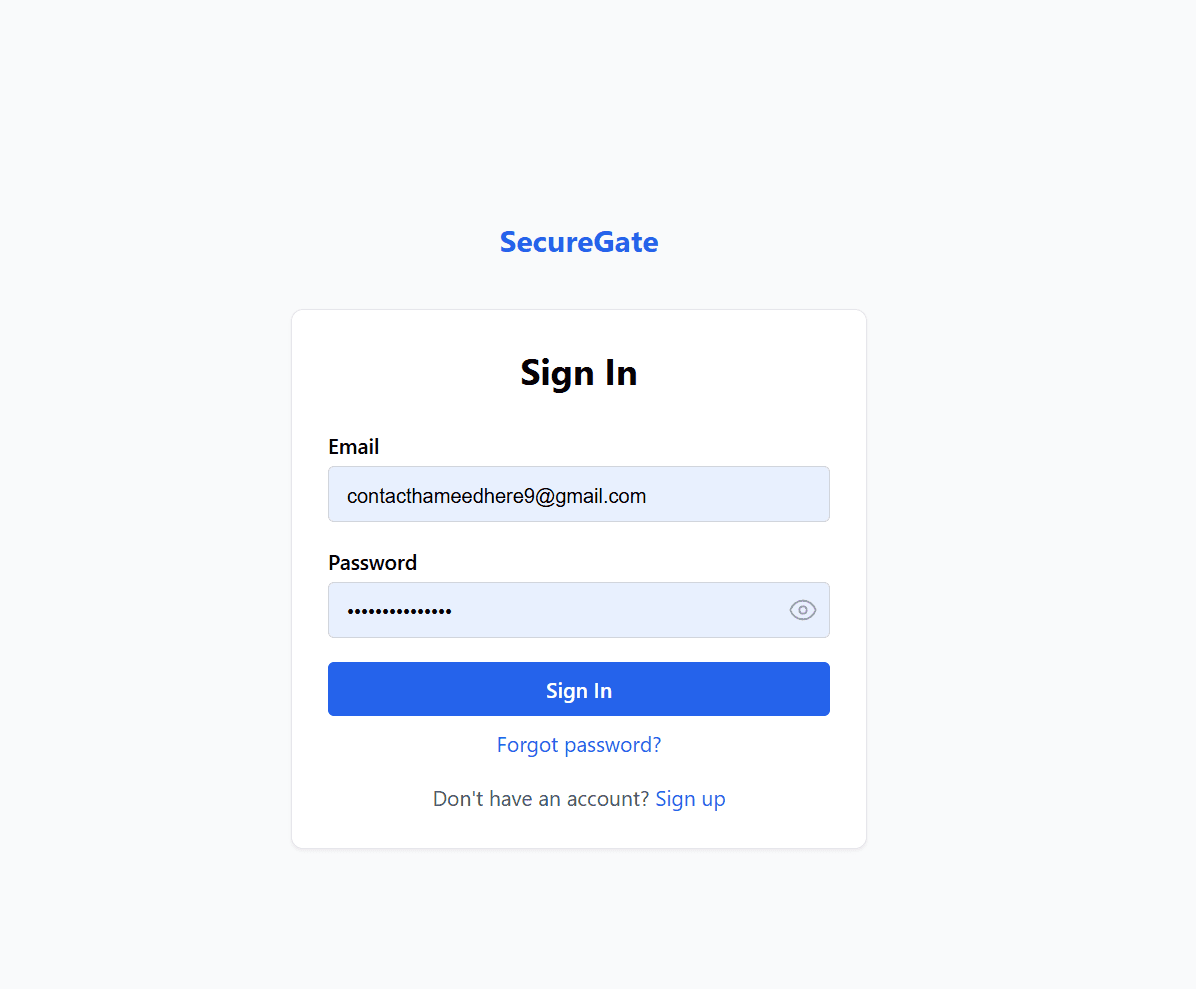
A working authentication product exploring how signup, verification, login, protected states, password recovery, and rate limiting can remain understandable as one connected system.
- Role
- Product Designer & Developer
- Client
- Personal Project
- Duration
- 1 day
- Year
- 2026
Overview
The product in context.
SecureGate is a working personal project focused on one connected authentication system: account creation, login, email verification, password recovery, session handling, protected routes, and rate limiting.
The tension
The product challenge.
Authentication is not one screen. It is a network of happy paths, errors, time-sensitive states, security constraints, and recovery routes. The design challenge was to make each state understandable while preserving the underlying access rules.
System problem
Authentication needed to remain legible across success, failure, and recovery.
- body
- A secure flow can still fail users when requirements, current status, and recovery paths are unclear. SecureGate treats identity, verification, session state, protected content, failure, and recovery as one product system.
Key decision
Make recovery and edge states first-class parts of the flow.
01
Context
Signup and login are only part of the authentication experience.
02
Decision
Design verification, invalid credentials, expired links, password reset, session expiry, and sign-out as connected states.
03
Why
Each state should explain what happened, what the user can do now, and what remains protected.
04
Trade-off
A complete state model requires more design and implementation work than polishing only the primary path.
Implemented evidence
The working product connects interface feedback with server-side rules.
- finding
- Sensitive flows need clear feedback without exposing unnecessary account information.
- evidence
- The implementation includes registration, login, email verification, password recovery, session handling, protected routes, server validation, and rate limiting.
- implication
- Interface copy and state transitions must reflect authoritative server responses; this implementation evidence is not a security certification.
Technical collaboration
Design decisions accounted for implementation constraints.
- finding
- Authentication behaviour depends on asynchronous and time-sensitive system states.
- evidence
- The product handles API latency, validation, token expiry, session state, route protection, and the distinction between client feedback and server authority.
- implication
- Technical fluency supports more realistic product specifications while remaining distinct from independent security review.
Learning
Low friction means necessary steps are understandable and recoverable.
- body
- The project reinforced that low friction does not mean removing every security step. Future work should test completion, error recovery, and comprehension with first-time and returning users.